
As financial institutions and corporate treasuries move beyond simply “holding” Bitcoin, they are increasingly looking at Decentralized Finance (DeFi) as a functional infrastructure for capital efficiency. This shift from passive investment to active participation is the hallmark of the current “Institutional DeFi” era.
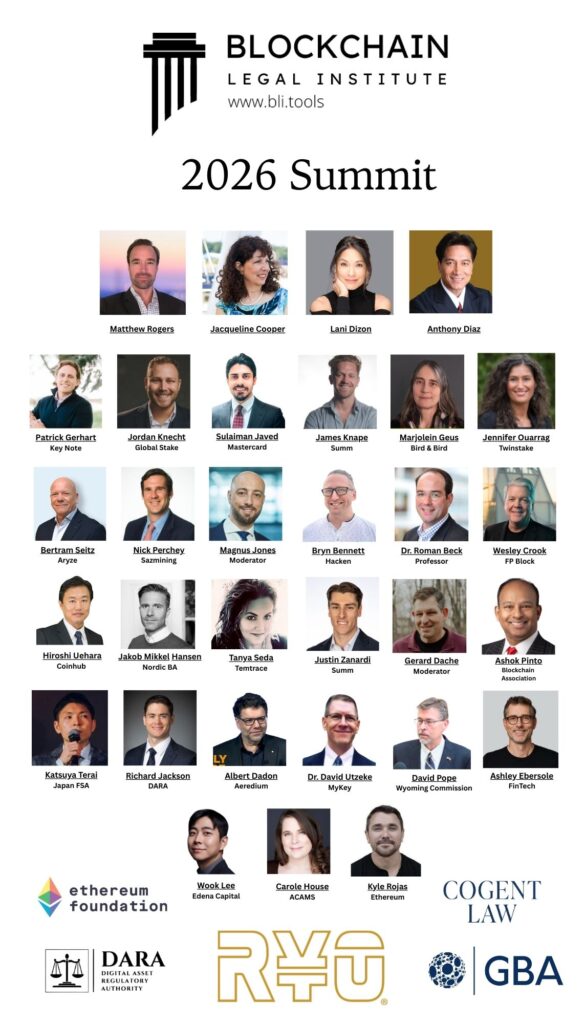
During the Blockchain Legal Institute’s 6th Global Summit, over 25 speakers reviewed the trends and challenges.
Primary Engagement Models
Institutions generally engage with DeFi through three primary “hooks”:
- Yield Generation (Staking & Lending): Instead of leaving cash idle, treasuries use regulated stablecoins (like USDC or PYUSD) to provide liquidity to automated protocols (e.g., Aave or Compound). This allows them to earn “on-chain yield” which often exceeds traditional money market rates.
- Tokenization of Real-World Assets (RWA): Institutions are bringing traditional assets—like Treasury Bills, Gold, and Real Estate—on-chain. This allows them to use these assets as collateral within DeFi protocols, increasing liquidity for otherwise “illiquid” holdings.
- Liquidity Management: Large entities use decentralized exchanges (DEXs) to swap large volumes of assets with lower slippage and 24/7 availability, bypassing the “banking hours” constraints of traditional finance.
The Shift to “Permissioned” DeFi
To meet regulatory and compliance standards (like KYC and AML), institutions rarely use “public” DeFi pools. Instead, they utilize Permissioned Pools:
- Verified Participants: Only entities that have undergone rigorous identity verification can enter the pool.
- KYC-at-the-Protocol-Level: Using “Soulbound Tokens” or digital IDs (like those promoted by the Blockchain Legal Institute) to ensure every counterparty is a known, legal entity.
Robust Risk Management Frameworks
For a Board of Directors to approve DeFi engagement, the risk management must be “Bank-Grade.” This involves:
- Smart Contract Audits: Before capital is deployed, the protocol’s code must be audited by top-tier firms (e.g., Trail of Bits, OpenZeppelin) to ensure there are no “backdoors” or logic errors.
- Oracle Reliability: Institutions ensure that the price feeds (Oracles) used by the protocol are decentralized and tamper-proof to prevent “flash loan attacks” or price manipulation.
- Insurance & Hedging: Utilizing on-chain insurance protocols (like Nexus Mutual) or traditional “slashing insurance” (critical for firms like Twinstake or Global Stake) to protect against protocol failure or validator penalties.
- Real-Time Monitoring: Using tools to monitor the health of collateral ratios 24/7, allowing for automated exits if market volatility threatens the principal.
4. Key Regulatory Considerations
As you will hear at the Global Summit, the “Regulatory Renaissance” is focused on:
- Custody: Who holds the private keys? (e.g., Self-custody vs. Qualified Custodians).
- Taxation: How are “gas fees” and “staking rewards” accounted for in corporate tax filings?
- Reporting: Ensuring on-chain movements are mirrored in traditional financial statements.