
Building Maryland’s Digital Future: Reflections on Joining the State Digital Asset & Blockchain Technology Task Force
Emerging technology moves fast, but the legal, regulatory, and economic frameworks that govern it must be built with deliberate care.
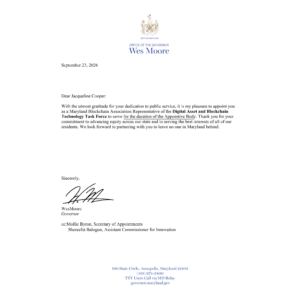
I am honored to share my appointment to the Maryland Digital Asset and Blockchain Technology Task Force.
As distributed ledgers, agentic artificial intelligence, and digital assets redefine commerce, banking, and public administration, state leadership faces a dual mandate: foster an environment where entrepreneurs and institutions can build, while establishing guardrails that protect consumers, homeowners, and working families.
Maryland is taking deliberate steps to meet this moment. Through the collaborative efforts of the General Assembly, state regulators, academic institutions, and regional industry coalitions, our state is establishing a balanced, innovation-ready regulatory landscape.
The Task Force Mandate: A Bridge Between Code and Law
Statutory bodies like the Digital Asset and Blockchain Technology Task Force serve as the vital bridge between software protocols and legislative reality. Bringing together legislators, financial regulators, academic scholars, and industry practitioners, the Task Force is tasked with analyzing the practical expansion of blockchain across Maryland’s economy.
Our work focuses on four core priorities:
-
Statewide Economic & Commercial Modernization
From evaluating how commercial banks and credit unions can compliantly adopt digital asset custody to reviewing payment stablecoins, our objective is to ensure Maryland businesses do not need to look across state lines for clear legal frameworks. Adopting modern commercial standards—such as Uniform Commercial Code (UCC) Article 12 to govern Controllable Electronic Records (CERs)—gives lenders, tech firms, and enterprises the commercial certainty needed to transact and collateralize digital assets with confidence.
-
Consumer Protection & Property Security
Innovation without accountability harms the public. A foundational focus of our state initiatives is mitigating emerging fraud vectors. Whether addressing predatory scams, securing virtual currency kiosk transactions, or studying blockchain-backed property records to prevent deed theft, consumer safeguards must be engineered directly into state policy.
-
Interoperable Public Sector Applications
Blockchain is not solely financial—it is institutional data infrastructure. We are analyzing how decentralized ledgers can optimize state operations, enhance municipal land governance, secure healthcare data exchanges, and introduce tamper-evident transparency into agricultural and supply chain traceability.
-
Workforce Pipelines & Academic Partnerships
Regulatory clarity alone is insufficient if our local workforce lacks the skills to operate within it. Maryland’s greatest asset is its educational and research ecosystem—spanning our university research hubs, community colleges, and vocational initiatives. By building turnkey academic curricula, continuing legal education (CLE), and real estate continuing education (CE) pipelines, we can train students, title examiners, and compliance professionals for high-placement careers in applied legal-tech and digital finance.
The Work Ahead: A Call to Collaborate
A task force is only as effective as the community it represents. Public policy cannot be drafted in an ivory tower; it requires continuous input from software engineers building smart contracts, compliance officers managing anti-money laundering controls, business leaders modernizing balance sheets, and citizens demanding transparent governance.
I look forward to collaborating closely with our state leadership, legislative sponsors, and the broader Maryland technology community. Together, we will ensure Maryland remains a national model for responsible, equitable, and forward-thinking digital governance.
Let’s get to work.
For updates on upcoming working group sessions, legislative briefings, and continuing education programs, visit the Maryland Blockchain Association