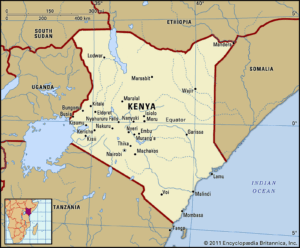

The International Partnership between DARA (www.dara.foundation) and the Virtual Asset Association of Kenya brings compliance training and international standards support to more than 50 Kenyan firms that must be licensed by Nov. 4
— The Digital Asset Regulatory Authority (DARA) and the Virtual Asset Association of Kenya (VAAK) announced a partnership today to help more than 50 Kenyan digital asset firms meet the country’s new licensing requirements before a Nov. 4 deadline, and to keep those requirements workable for the Kenyans who use digital assets to send money home, pay suppliers and invest for a prosperous future.
The Virtual Asset Service Providers Act, 2025, which took effect Nov. 4, 2025, requires anyone offering virtual asset services in or from Kenya to hold a license from the Central Bank of Kenya or the Capital Markets Authority. The National Treasury gazetted the implementing regulations on July 22, 2026, and under Section 47 of the act, firms already operating when the law took effect have until Nov. 4, 2026, to comply. That leaves weeks for exchanges, wallet providers, payment processors and stablecoin issuers to meet fit-and-proper tests, capital requirements that reach 300 million Kenyan shillings, or about $2. million, for stablecoin issuers, and new anti-money laundering and consumer protection obligations. That threshold is down from the 500 million shillings proposed in a March draft that VAAK had publicly warned would push startups out of the regulated market. Under the agreement, DARA will supply regulatory research and comparative analysis of how other jurisdictions have licensed virtual asset providers. The two organizations will hold joint workshops for VAAK members on licensing, capital, governance and anti-money laundering requirements, coordinate engagement with Kenya’s regulators and international bodies, and work to align Kenya’s framework with the Financial Action Task Force’s recommendations on virtual assets.
“Kenya wrote a complete rulebook for virtual assets and gave the industry a firm date to comply,” said Matthew Rogers, Strategic Director of DARA. “Our role is to support stakeholders to make sure Kenyan firms have the research, training and international perspective to get licensed and grow ” The stakes reach well beyond the industry. Chainalysis, the blockchain analytics firm, ranks Kenya among the five largest recipients of on-chain crypto value in sub-Saharan Africa, a region where it says small retail transfers make up a larger share of activity than anywhere else in the world and stablecoins settle trade payments. Diaspora remittances reached a record $5.04 billion in 2025, according to the Central Bank of Kenya, which calls them a key source of foreign exchange, while sending money to sub-Saharan Africa remains the most expensive in the world, at an average of 8.5% on a $200 transfer, according to the World Bank’s latest survey of remittance prices. At that volume, every percentage point cut from transfer costs is worth roughly $50 million a year to Kenyan families and the relatives who send to them. Kenya has been on the Financial Action Task Force’s gray list since February 2024. When the watchdog placed Kenya under increased monitoring, adopting a legal framework to license and supervise virtual asset providers was among the actions it required, and Treasury officials have since cited the act as a milestone toward exiting the list. Seven items remained on Kenya’s action plan at the FATF’s June 2026 review, including risk-based supervision of financial institutions, and a licensed, supervised virtual asset sector supports that effort.
“Our members asked for clear rules, and Kenya delivered them. Now they have to meet those rules without losing the customers who depend on them,” said Dr. Peter Onyango, chairperson of VAAK. “Working with DARA gives our smaller firms access to international expertise they could not otherwise reach.”
Kenya is among the first countries in East Africa to bring a complete licensing regime for virtual assets into force. DARA, which also works with industry bodies and policymakers elsewhere in Africa, said the partnership aims to help rules across the region converge rather than fragment.
About the Digital Asset Regulatory Authority – The Digital Asset Regulatory Authority is a global initiative advancing sound, consumer-protective regulatory frameworks for digital assets. Housed under the Blockchain Legal Institute Foundation, a U.S. nonprofit, DARA works with regulators, industry associations and legal experts worldwide on consumer protection, estate planning for on-chain assets and regulatory advocacy. Learn more at dara.foundation.
About the Virtual Asset Association of Kenya – The Virtual Asset Association of Kenya represents more than 50 digital asset firms operating in Kenya. Launched in Nairobi in December 2025 after enactment of the Virtual Asset Service Providers Act, 2025, VAAK is the primary interlocutor between the industry and Kenyan regulators.