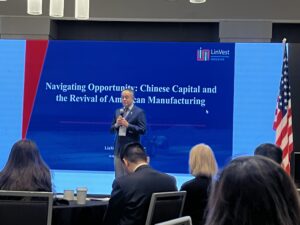
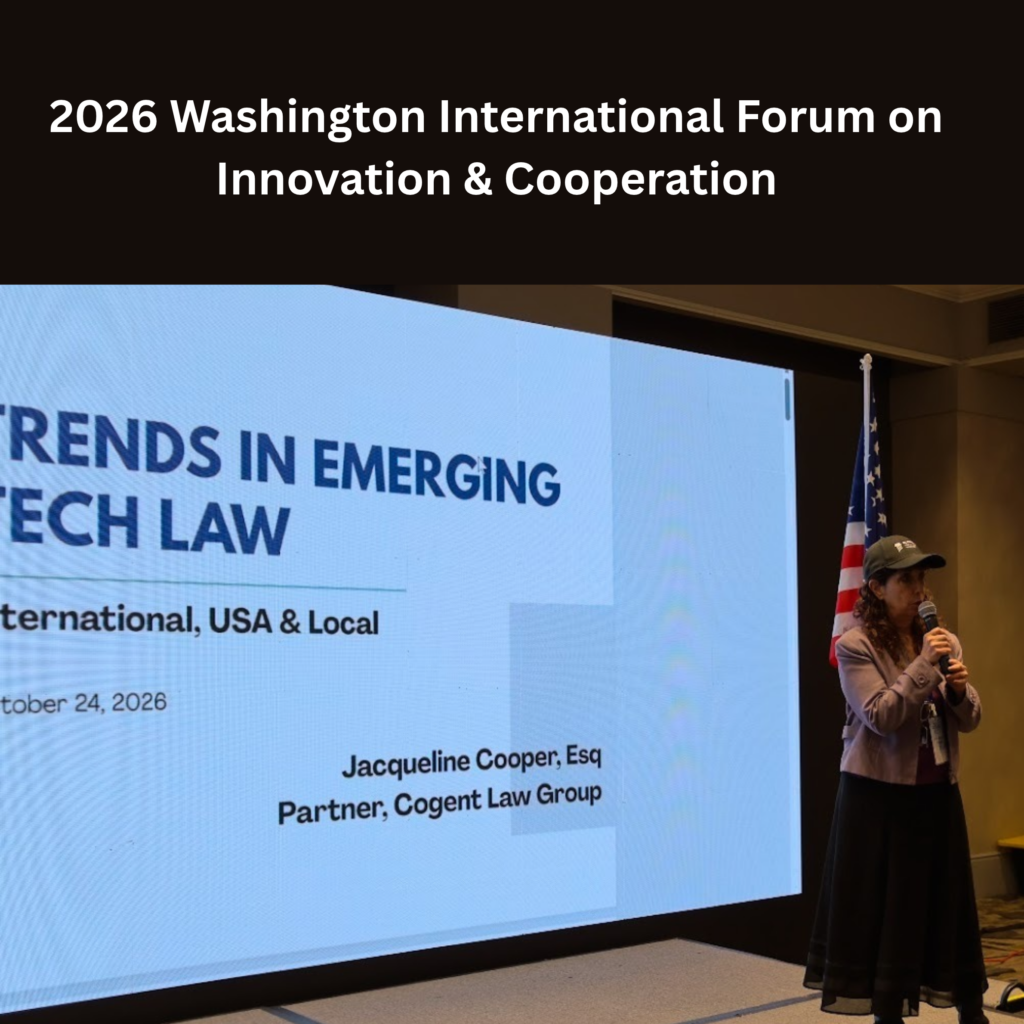
At the 2026 Washington International Forum on Innovation & Cooperation, held on Saturday, October 24, 2026, at the Marriott Hotel in Bethesda, Maryland, international delegates, state leaders, and emerging technology executives gathered to address cross-border collaboration in the era of artificial intelligence and digital assets. Convened by the US-Sino Innovation Alliance (USIA), the forum brought together key policymakers—including remarks from Maryland Secretary of State Susan Lee, Montgomery County Executive Marc Elrich, Maryland Senator Clarence Lam, and representatives from the U.S. Congress, Virginia Legislature, and international trade bodies.
During the afternoon Finance & Cross-Border Capital panel (moderated by Yingxia Yang), Jacqueline Cooper presented on “Trends in Emerging Tech Law: International, USA & Local” representing the Digital Asset Regulatory Authority (DARA), the Blockchain Legal Institute (BLI), the Maryland Blockchain Association (MBA), and Cogent Law Group. Sharing the stage with Paul Liu (Founder, PQC Public Blockchain) and Ken Huang (author and researcher in Agentic AI), the discussion centered on establishing reliable legal frameworks, enterprise safeguards, and statutory modernization as financial settlement transitions from human batch processing to continuous, autonomous execution.
Global and Domestic Alignment: DARA, BLI, and MDBA
Addressing cross-border digital economy challenges requires multi-layered institutional coordination across local, national, and international spheres:
-
Digital Asset Regulatory Authority (DARA): Providing institutional and governmental advisory services, regulatory sandboxes, and specialized task forces—such as the Asian Digital Asset Regulation Task Force—to foster economic development while upholding market integrity, consumer safety, and compliance.
-
Blockchain Legal Institute (BLI): Serving as a centralized educational research engine and resource clearinghouse dedicated to modernizing legal systems, training workforces, and bridging policy gaps through AI and blockchain integration.
-
Maryland Blockchain Association (MBA): Spearheading regional legislative modernization, collegiate workforce partnerships, and major initiatives such as the annual International BlockchAIn & Workforce Expo Conference.
-
International Horizons & Economic Dialogues: Aligning legal governance and cross-border innovation with global trade platforms, including international roundtables and trade frameworks such as the Hainan World Economic Forum.
Core Emerging Technology Law Trends
The presentation examined five structural legal and regulatory vectors defining modern tech governance:
-
Artificial Intelligence Governance & Algorithmic Liability: Defining statutory responsibility for autonomous agent decisions, setting legal parameters for machine-executed contracts, and auditing model bias and agentic actions.
-
Digital Assets, Distributed Ledgers & Payment Systems: Transitioning from legacy batch-clearing architectures (ACH, SWIFT) to 24/7 continuous settlement via wholesale tokenized deposits, regulated stablecoins, and autonomous treasury rails.
-
Data Privacy, Biometrics & Automated Decision-Making: Formulating transparent guardrails for machine data extraction, algorithmic consent, and biometric identification frameworks.
-
Cybersecurity, Infrastructure Resilience & Cryptography: Incorporating zero-trust multi-party computation (MPC) and post-quantum cryptographic defenses to protect high-value smart contract infrastructure and data pipelines.
-
Autonomous Systems, Robotics & Spatial Computing: Establishing jurisdictional standards for machine-to-machine interactions, physical IoT data verification, and autonomous agentic commerce.
Key Areas of Need in Frontier Tech
While technological capabilities continue to accelerate, real-world deployment frequently encounters regulatory friction and commercial bottlenecks. The discussion identified five urgent areas where legal engineering and public-private cooperation must bridge the gap:
-
Technical Workforce & Executive Talent Pipelines: Closing the skills deficit by aligning university curriculums and continuing education programs with high-demand careers across cybersecurity, prompt engineering, legal tech, and digital treasury operations.
-
Structured Regulatory Sandboxes & Municipal Pilots: Providing legally defined environments where state agencies, financial institutions, and tech innovators can safely test decentralized protocols, supply chain ledgers, and automated agent workflows before broad commercial deployment.
Anchoring Sustainable Innovation
As machine-to-machine value exchange expands, trust cannot remain an abstract concept. It must be built upon verifiable cryptographic code, proactive workforce upskilling, and enforceable statutory frameworks.
Through collaborative forums like the Washington International Forum on Innovation & Cooperation, organizations like DARA, BLI, and the Maryland Blockchain Association will continue working alongside legislators, academic institutions, and enterprise leaders to establish the legal, compliance, and educational bedrock needed for sustainable frontier technology adoption.